Consumer purchasing behaviour has changed significantly with digitalisation. Today, customers don’t make purchasing decisions based solely on a product’s appearance or price – there is a growing need to obtain additional information about products before making a final decision to part with their money. According to a study, as many as 25% of consumers consider detailed and accurate product information to be the most important factor influencing their purchasing decision. This means it is vital for stores to ensure that customers have access to comprehensive product information easily and quickly.
Electronic shelf labels (ESLs) are a practical solution to this challenge. They not only outperform traditional paper labels in terms of time savings, but also allow far more diverse product information to be displayed directly alongside the product. In addition, ESLs can display QR codes that customers can scan to explore product details even further. At the same time, the store gains valuable data on customer behaviour in the store, as QR code scans are recorded per store and per product.
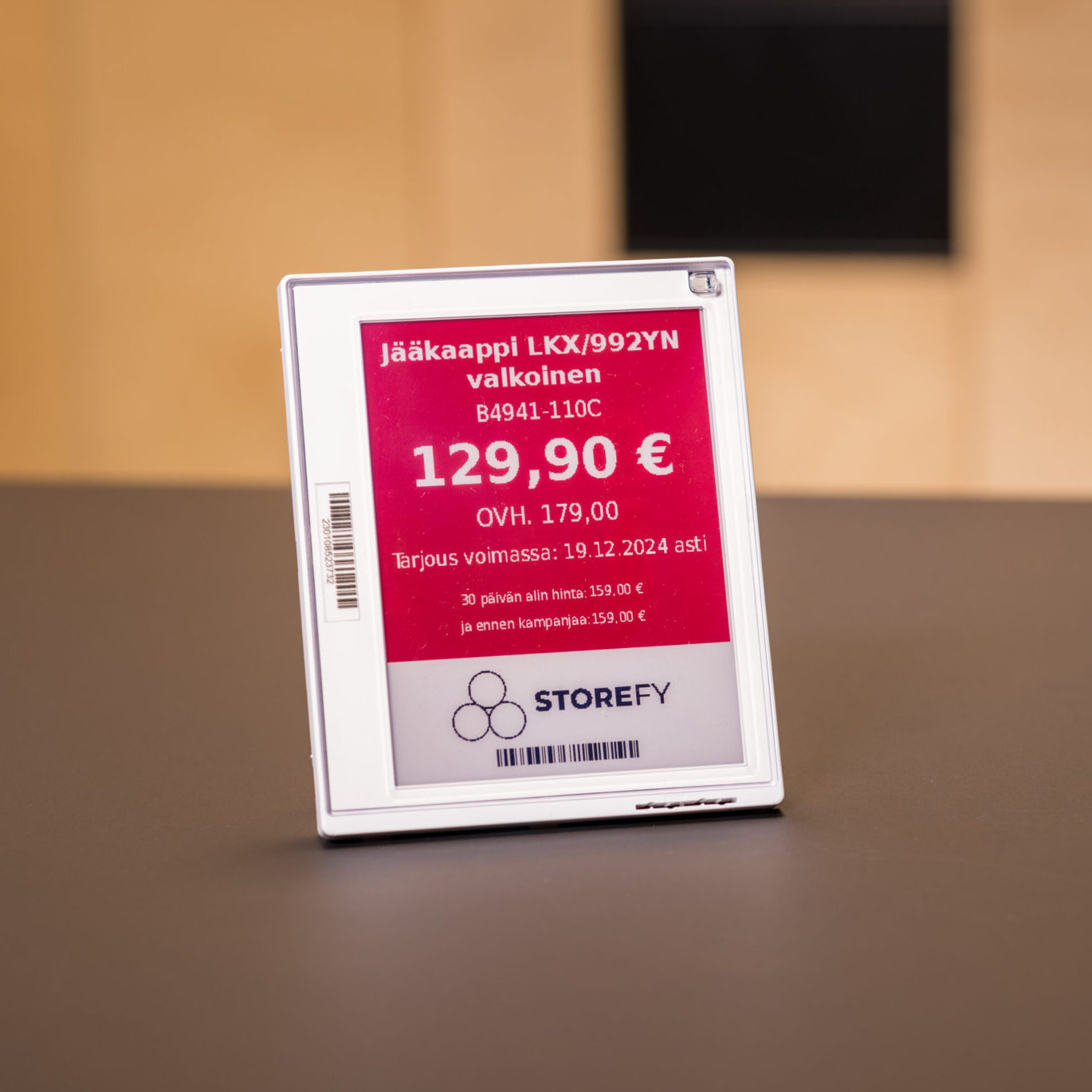
Traditionally, price labels have offered only the most basic information, such as the product name and price. This is no longer sufficient for many consumers, who wish to compare features before buying. With electronic shelf labels, even a 4.2-inch display can show more product information, such as key features, technical specifications, or customer reviews. This reduces the need for customers to seek out a sales assistant and makes it easier to compare products within the same category.
In addition, electronic shelf labels ensure that pricing and product information always stay up to date. Managing prices and campaigns centrally prevents pricing errors and ensures customers always receive the most current information.

QR codes are a bridge between the physical and digital store experience
Additional information that cannot fit on a digital shelf label can be accessed via a QR code. Customers can conveniently scan the code with their phone to read in-depth details on the company’s website or online store. The QR code on a digital shelf label updates automatically, ensuring the customer looking for more information always lands on the correct page.
QR code scanning collects valuable data
One of the greatest advantages of electronic shelf labels and QR codes is the analytics they generate. Each label can contain a unique QR code, making it possible to track exactly where a scan took place and which product generated interest. This information can be combined with sales data to analyse:
Which products generate a lot of interest but don’t necessarily end up in the shopping basket?
In which parts of the store are QR codes scanned most frequently?
How does QR code usage correlate with sales?
Through this analysis, stores can optimise their campaigns, product displays, and range. For example, if a product receives many scans but sales remain low, a price adjustment, additional marketing, or an improved display could be considered.

Summary
Electronic shelf labels and QR codes allow stores to improve the customer experience while simultaneously collecting valuable data on the factors behind purchasing decisions. Research data shows that the availability of comprehensive product information significantly influences purchasing decisions, and electronic shelf labels meet this need by offering diverse information directly at the point of purchase. QR codes, in turn, connect the physical store experience to the web, making it easier for customers to find information and enabling more informed purchasing decisions. At the same time, the store gains valuable analytics on customer behaviour that can be used to develop the business.
Using electronic shelf labels and QR codes is not merely a technological solution, but a strategic way to improve the customer experience, streamline operations, and optimise sales through data.
doop | Kauppiaskatu 5, 1st floor, 20100, Turku | info@storefy.fi | +358 2 4802 7650
Customer service | +358 2 4802 7660 | Open on weekdays 9–17
storefy is a registered trademark of doop oy
sensorbeacon is a registered trademark of doop oy