25.4.2025

Measuring marketing results in-store, where the physical and digital worlds meet

Measuring marketing is commonplace in digital channels, but physical stores can now harness data too. In this article, we compare measurement methods in the digital and physical worlds and explain how in-store marketing can become genuinely data-driven.

Marketing performance is easy to measure in digital channels. Clicks, impressions, conversions, and attribution models clearly show which messages work and which do not. In a physical store, however, the effectiveness of marketing has traditionally been harder to evaluate other than by monitoring cash flow. Decisions in in-store marketing have largely had to be based on guesswork, intuition, or an indirect interpretation of sales figures. 

This is now changing. With new technology, physical stores can accurately measure the impact of marketing and the true conversion rates of campaigns, without any extra effort.

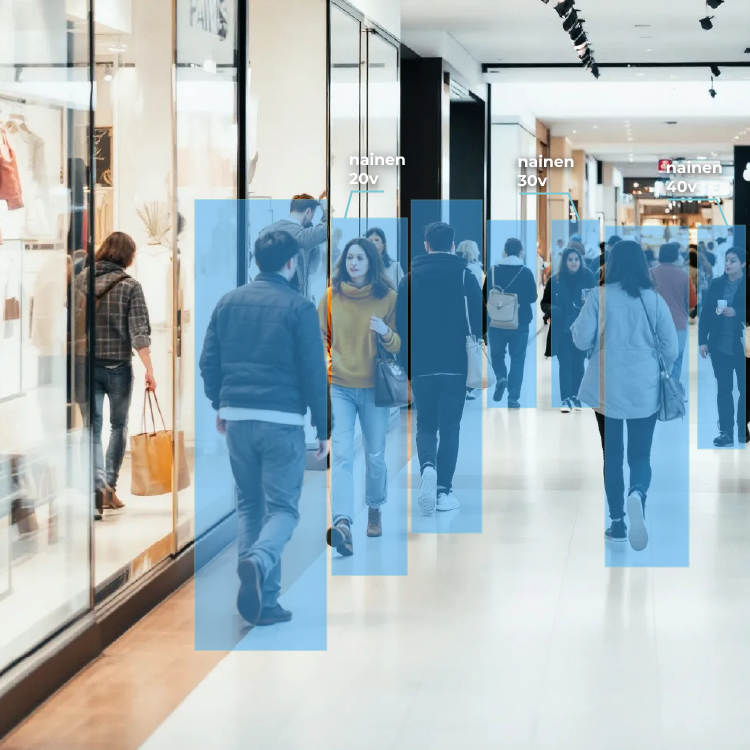
Physical vs. digital environment – what can be measured?

Digital marketing offers almost unlimited possibilities for measurement. Ad impressions, clicks, purchase events, and user browsing behaviour on a website are all recorded automatically. Analytics tools enable a rapid response and continuous campaign optimisation. A/B testing, remarketing and personalisation are straightforward to implement.

In physical stores, on the other hand, the effectiveness of campaigns has typically been assessed using sales figures, customer surveys, or flyers and vouchers. While these provide some signals regarding customer behaviour, they are nowhere near as precise or agile as digital marketing tools.

Footfall & Visitor Analytics Counter reveals previously hidden data

With the Footfall & Visitor Analytics Counter, the person responsible for a store’s marketing can determine how effectively marketing efforts are actually reaching customers passing by outside. A traditional visitor counter makes it possible to see how many people come inside, but not how many people could have come inside. The day’s visitor count may look good if more people than average visited the store on a given day. But what was the underlying reason for the higher visitor count? Successful in-store marketing, or simply the fact that more people were out and about anyway? The Footfall & Visitor Analytics Counter provides information on both of these with a single device, allowing the store’s marketing manager to draw clear conclusions regarding marketing effectiveness.

Measure the impact of an individual campaign on the conversion rate

With the Footfall & Visitor Analytics Counter, it is possible to find out what proportion of passersby have converted into customers inside – in other words, how effective external communication has really been. But how do you know what marketing message was on display at that moment, or at just the right time beforehand? If the marketing was carried out via television advertising, for example, you can place the passerby and visitor numbers side by side with the advertising broadcast times and determine whether the advertising led to a higher conversion rate. When the timings align and visitor numbers or the conversion rate change noticeably, well-founded conclusions can be drawn about the campaign’s effectiveness in terms of drawing people into the store.

In this way, it can be determined whether a particular advertising message has influenced passersby to step inside the store. Analysing this first point of conversion tells the marketer a great deal about the success of external communication: was the message compelling, was the campaign timed correctly, and did it stand out from its surroundings effectively?

Always aim for improvement

Comparing marketing activities against conversion data enables continuous optimisation. If, for example, it is noticed that a particular visual style or campaign message consistently results in higher visitor numbers, this information can be used in future planning. Conversely, if a campaign does not deliver the expected results, it is possible to quickly identify at which stage of the customer journey the impact falls short and respond accordingly.

This comprehensive view of the relationship between marketing activities and customer traffic enables a new way of managing in-store marketing – data-driven, agile, and transparent. No more guessing about what worked and what did not; every campaign can be analysed objectively.

Summary

Just like digital channels, the marketing of a physical store can now be measured accurately and in real time. Thanks to advanced technologies such as passerby and visitor counters and intelligent systems, marketers have access to valuable data that previously remained hidden. This allows them to evaluate the effectiveness of campaigns across the entire customer journey, from the impact of external communication all the way to changes in purchasing behaviour.

By combining customer flow and sales data, campaigns can be optimised in the same way as in digital channels. Marketing decisions are now based on knowledge rather than assumptions, and the physical store becomes an active part of analytics-driven marketing. In this way, the store environment is no longer merely a point of sale, but also a platform for experimentation and continuous development.