26.6.2026

Footfall counter: how modern visitor analytics improve retail performance

You already know how many products you sold today. But do you know how many people walked past your shop without coming in?

What is a footfall counter?

A footfall counter is a system that measures the number of people entering — and increasingly, passing by — a physical retail location. The term covers everything from a basic door sensor to a sophisticated people-counting system that tracks customer flow, dwell time, and behaviour throughout the store.
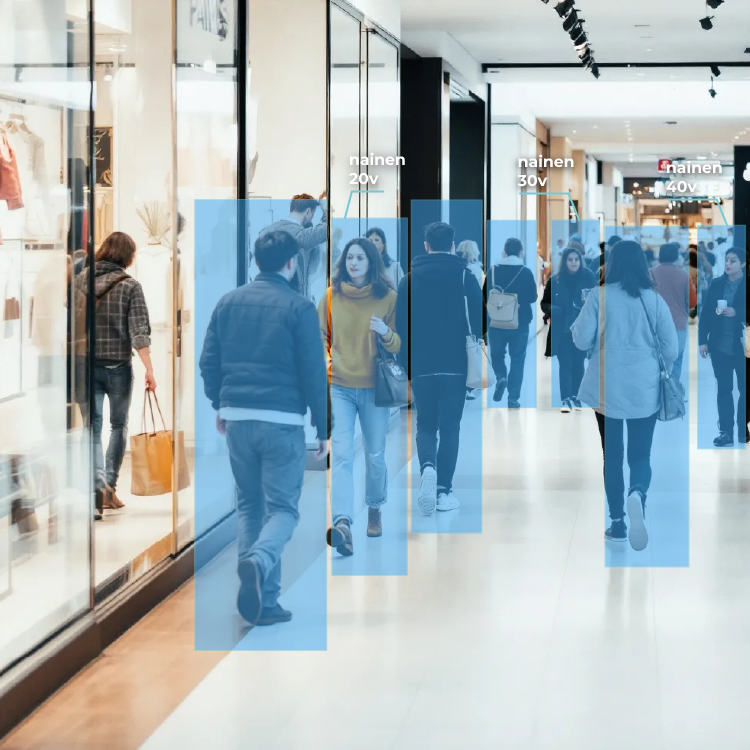
Traditional footfall counters did one thing: count heads at the door. Modern visitor analytics platforms do far more. They capture passer-by traffic outside the entrance, conversion rates from street to store, peak hours and quiet periods, movement patterns inside the store, and the relationship between visitor numbers and actual sales.

The result is a data set that turns gut feeling into informed decision-making.

Why footfall analytics matter in retail

Retail has always been competitive. But the pressure on physical stores has intensified as online shopping becomes the default for an ever-wider range of purchases. The stores that thrive are those that understand their customers — not just what they buy, but how they behave before they buy.

Footfall analytics provide that understanding.

  • Conversion rate is the metric most retailers overlook

    Sales figures tell you how many people bought. Footfall data tells you how many people could have bought. The gap between the two — your conversion rate — is one of the most powerful indicators of retail performance, and one that most stores have never properly measured.

    If 500 people enter your shop on a Saturday and 80 make a purchase, your conversion rate is 16%. Is that good or bad? It depends on your category, location, and competitors. But without footfall data, you would never even know the number.

  • Staffing decisions become evidence-based

    One of the most immediate practical benefits of people counting is smarter staffing. When you know exactly when your busiest periods are — not approximately, but by the hour — you can schedule staff accordingly. Fewer staff during quiet periods reduces costs. More staff during peaks improves service and, typically, sales.

  • Store layout and merchandising stop being guesswork

    Retail footfall analytics reveal how customers actually move through a store, not how you assume they do. Which areas attract attention? Where do people linger? Which displays are passed without a glance? This data drives better decisions about product placement, signage, and promotions.

  • Marketing effectiveness becomes measurable

    Did that window campaign last week drive more footfall? Did the weekend promotion actually bring people in, or did sales just come from existing visitor volumes? With retail traffic analytics, marketing investments can be evaluated against real visitor data rather than estimated impact.

From door counter to customer flow analytics

The evolution from a simple door counter to a full customer flow analytics platform represents a significant shift in what retailers can understand about their business.

A basic infrared beam counter at the entrance captures entries and exits. It is better than nothing, but it tells you little about what happens once a customer is inside — or why footfall fluctuates from one day to the next.

Modern people counting systems use a combination of technologies — including overhead sensors, camera-based counting, and Wi-Fi analytics — to build a far richer picture.

Key capabilities include:

Passer-by counting

Measuring traffic outside the entrance, not just inside, to calculate the true conversion rate from street to store

Zone analytics

Understanding which areas of the store attract visitors and for how long

Queue detection

Identifying when and where queues form, enabling faster responses

Time-series data

Tracking patterns across hours, days, weeks, and seasons to support planning

Key capabilities include:

Passer-by counting

Measuring traffic outside the entrance, not just inside, to calculate the true conversion rate from street to store

Zone analytics

Understanding which areas of the store attract visitors and for how long

Queue detection

Identifying when and where queues form, enabling faster responses

Time-series data

Tracking patterns across hours, days, weeks, and seasons to support planning

When visitor analytics are integrated with sales data, the picture becomes even clearer. You can see not just how many people visited, but which visits resulted in purchases — and start to understand why.

Connecting footfall data with digital signage performance

One of the most powerful developments in retail visitor tracking is the integration of footfall analytics with digital signage. When you know how many people are in the store — and where — you can adapt your in-store communications accordingly.

High footfall at the entrance? Trigger your most compelling promotional content. Quiet period approaching? Adjust messaging to drive engagement. A particular display consistently drawing traffic? Use that insight to inform your wider merchandising strategy.

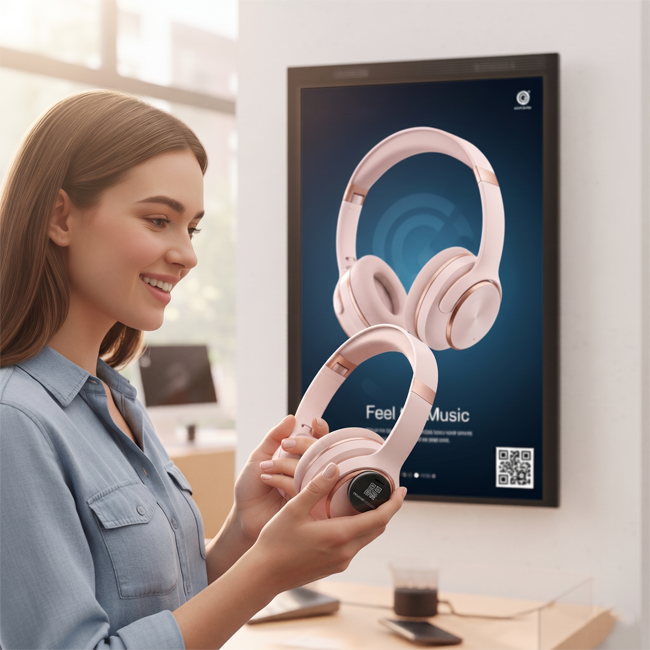
Nainen pitää käsissään vaaleanpunaisia langattomia kuulokkeita, joihin on kiinnitetty sensori. Sensori käynnistää kuulokkeista videon, joka näkyy mainosnäytöllä naisen edessä. Tilanne kuvastaa, miten visuaalinen tarinankerronta on mahdollista digitaalisten mainosnäyttöjen avulla.

This connection between visitor data and content performance closes a loop that most retailers have never been able to close: the relationship between what you communicate and how customers actually respond.

What to look for in a retail footfall analytics solution

Not all people counting systems are equal. When evaluating options, retailers should consider:

  • Accuracy

    Consumer-grade sensors vary widely in accuracy. Look for systems that have been validated in real retail environments, not just laboratory conditions.

  • Passer-by measurement

    A solution that only counts entries misses half the picture. Passer-by data is essential for calculating true conversion rates and understanding the drawing power of your location and window.

  • Integration capability

    Footfall data is most valuable when it connects with your existing systems: point-of-sale, staffing, and marketing platforms.

  • Ease of use

    Data is only useful if it is acted upon. Look for clear dashboards and reporting that make insights accessible to store managers, not just analysts.

  • Scalability

    Whether you operate one store or one hundred, the system should handle your network without requiring a different solution at each scale.

storefy footfall & visitor analytics counter

storefy’s footfall and visitor analytics solution is built specifically for physical retail. It measures both in-store visitors and passer-by traffic, giving retailers the full picture from street to sale.

What sets it apart is the integration with digital signage performance data. Rather than treating footfall counting and in-store communications as separate systems, storefy connects them — so retailers can understand not just how many people visit, but how their store environment influences customer behaviour and buying decisions.

As a Finnish Avainlippu-certified company, storefy combines local expertise with a platform designed for the demands of modern retail — from independent shops to multi-site chains.

Summary: footfall analytics as a foundation for retail growth

A footfall counter is no longer just a door sensor. Modern retail footfall analytics give physical stores the kind of customer insight that online retailers have had for years: who visits, when, where they go, and how they behave.

For retail managers and marketing decision-makers, that data is the foundation for better staffing, smarter merchandising, more effective campaigns, and — ultimately — stronger sales performance.

The question is no longer whether to measure footfall. It is what you will do with the insight once you have it.

Ready to see what your store’s visitor data can tell you?