7.5.2025

Traditional advertising stand or Digital A-Board?

A customer’s experience of a store begins before they even step inside. It is shaped by factors such as the store’s location, façade, shop window, product displays, cleanliness, and of course the products and offers visible from outside. Some of these things can be influenced more than others.

When it comes to actively marketing a store near its location, the first thing that comes to mind is the traditional, self-standing, A-shaped advertising stand. A printed or hand-written poster communicates one specific marketing message in large letters: an offer, a new product, a sale, or something else. This kind of traditional advertising stand is a simple, reliable, and affordable medium – as long as up-to-date advertising materials are ready to hand, or the business has staff with a talent for lettering. A stand made of thin metal tubing is also easy to set up and move around, and it isn’t particularly susceptible to changes in the weather either, so it can safely be left in blazing sunshine or at the mercy of the frost. All in all, quite a capable piece of kit.

Room for improvement in attention value

The list of things a roadside or shopping centre aisle advertising stand cannot do is rather longer, however. Perhaps most importantly, a static advertising poster doesn’t ultimately attract passersby’s attention very effectively, unless their gaze happens to land on it – or they trip over the stand itself.

A person sees thousands of marketing messages that qualify as advertising in the course of a day, so competition for customers’ attention is fierce. A motionless poster below the eye level of a walking person isn’t exactly an attention magnet, unless the message on the advertisement – half-price ice fishing overalls, say – happens to fall within the perceptual field of someone who is specifically looking for new ice fishing overalls.

The fold-up stand doesn’t bend to everything

A second mark against the A-board and poster column comes from the fact that it’s not possible to react very quickly to situations that change unexpectedly or to sales opportunities that suddenly arise – at least not with on-brand communication. If, for example, an advertised promotional product runs out, the options are to haul the entire stand out of sight or hastily put together a new, updated advertising poster. This, of course, takes staff time away from actual sales work.

A traditional advertising stand that communicates via printed posters is therefore cheap, portable, and simple, but not particularly effective or adaptable as an advertising medium. The underlying idea is sound; however, the aim is to get customers interested while still outside the store and to convert passersby into customers.

The Digital A-Board – a challenger from the future

Retailers have a great deal they would like to tell the passersby whose unbroken stream seems to flow relentlessly past the store. Even the best product display doesn’t help if people don’t yield to its appeal. Trying to attract a crowd of shoppers with a single marketing message is like trying to catch a shoal of fish with a single baited hook. Closer to a trawler is the Digital A-Board – a modern and considerably improved version of the familiar advertising stand.

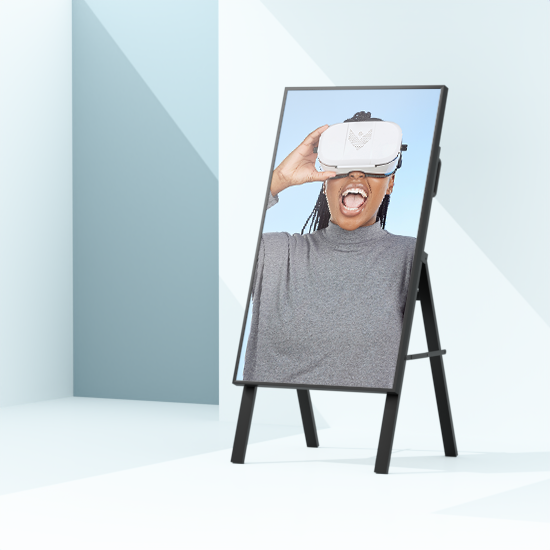
Digitaalinen A-ständi esittää naista virtuaalilasien kanssa modernissa sisätilassa.

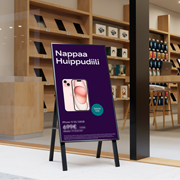
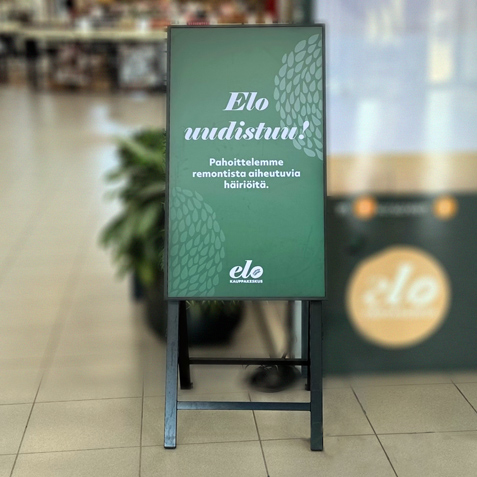
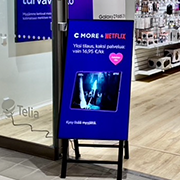
Visually, the Digital A-Board resembles a traditional advertising stand: it is self-standing, A-shaped, and displays advertisements. The key difference, however, is that the frame supports not a poster but a bright, high-resolution digital display. It therefore falls into the digital signage category, which includes advertising and info displays and electronic shelf labels, among others. Instead of a single advertising message, the Digital A-Board can show multiple different pieces of content: images, text, and above all videos. Moving image is like candy for our senses – it doesn’t go unnoticed.

What our customers say

Telia

The Digital A-Board has generated sales. More of these!

Sales Associate, Telia Store

Kauppakeskus Elo (Shopping Centre)

We adopted storefy's Digital A-Board and have been extremely satisfied with it. Managing materials is easy and smooth, which allows us to respond quickly even to sudden communication needs at the shopping centre.

Timo Matinlompolo, Shopping Centre Manager, Sponda Oy / Kauppakeskus Elo

Telia

I feel that the Digital A-Board is a great addition. It brings professionalism and sparks customers' interest.

Sales Associate, Telia Store


Moving image is an unrivalled sales booster

Movement captures human attention, and we can’t help it – it is built into our DNA. The fact that our senses are alert to movement and changes in the environment is a product of evolution. The individuals who survived were those who detected the approach of predators and, conversely, located prey and obtained more food. Movement has always been either a threat or an opportunity, which is why it has paid to pay attention to it.

Applied to the modern day, it can also be said that moving images trigger stronger reactions in the brain and stimulates more areas of it. Movement conveys emotion and dynamism, making it attention-grabbing and engaging. According to research, a moving image is 400% more appealing than a still image.

Get ’em while they’re hot – timing in marketing matters

Advertising is most effective when a person can act on it immediately after seeing or hearing it – by stepping into a store, for example. A television advertisement seen the previous evening is quite a long time and journey from the store checkout. Online retail doesn’t have this problem, but in the case of a physical store, the further an advertising message is from the actual purchase event, the greater the chance it will have been forgotten by then.

Read also:: Where to get content for digital signage displays?

People milling around a shopping centre aisle are the perfect target group for in-store advertising. They have already chosen to come to a place whose sole purpose is to sell products and services, and they are actively looking for something that interests them. That makes the most opportune moment to reach a potential customer precisely when they are near the store. If multiple pieces of advertising content can be shown to them, the probability that one of them will make a passerby stop being a passerby increases considerably. This is where the Digital A-Board clearly outperforms the traditional A-frame with its single, static advertising poster.

But it says on that poster that…

Easy and fast updatability might at first seem like one of the strengths of a simple poster stand: take down the old poster and put up a new one. The matter isn’t quite that straightforward, though. The need for an update has to be identified first. An old advertisement easily ends up still proclaiming an outdated message, and someone has to actually go and change it as well.

The digital version wins this round too, as the advertising display’s management system allows advertisements to be scheduled for display well into the future. Content is always up to date, and for unexpected situations, easy and near-automatic tools exist for producing entirely new, high-quality, on-brand content. On top of staying current, staff time is freed up for actual sales work.

Advertising stand or digital advertising display?

The result of the comparison may seem quite overwhelmingly in favour of the Digital A-Board, but in the interest of honesty it must be said that a traditional advertising stand is a good solution in certain situations. If an A-frame is outdoors and exposed to the weather, or if it is a single store with a narrow product range, acquiring a digital signage system is perhaps a little over the top. If there are three or more stores, however, the Digital A-Board delivers both significant savings and sales growth that shows on the bottom line.

Read also: 5 benefits when you get a digital signage display for your store